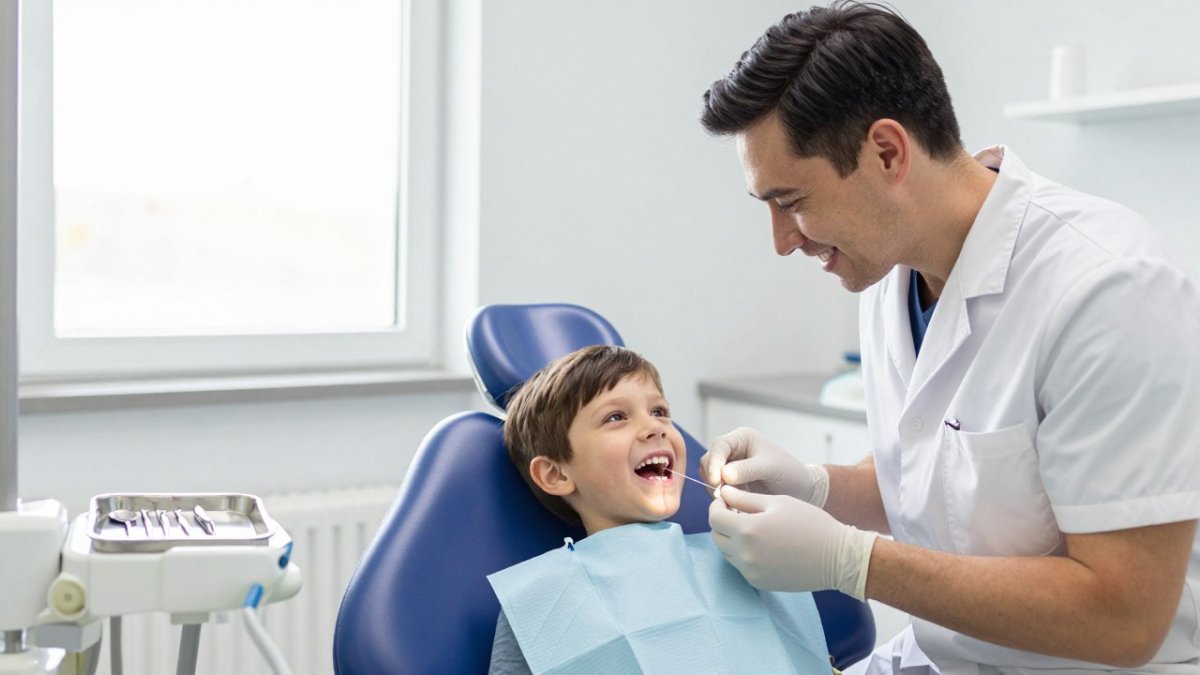
 How-to
How to Prepare Your Child for Their First Dental Filling
Last Updated: November 24, 2026
Quick Summary
To learn how to prepare your child for their first dental filling, explain the visit in plain, honest words and give them a hand-raise signal to pause. Practice with role-play and dentist-themed books, and never promise there will be no shot if the dentist plans to use one.
- Kids take their cues from you, so a calm parent who explains the visit in plain words usually has a calmer child.
- For kids under five, skip words like drill, needle, and shot, and say tooth cleaner and sleepy gel instead.
- A child's dental filling follows a predictable five-stage sequence, and knowing the steps helps you explain them ahead of time.
- A child can get a filling without an injection when the cavity is shallow and sits near the surface of the tooth.
- Numbness usually wears off within a few hours, and until it does, keep kids away from snacks to prevent biting injuries.
Table of Contents
- Start With Calm: What to Tell a Child Before a Dental Filling
- What to Expect During a Child's Dental Filling
- How Long Does a Child's Dental Filling Take?
- Can a Child Get a Filling With No Injection?
- Appointment-Day Checklist and Prep for Eating, Drinking, and Medications
- If Your Child Gets Distressed: Tips for Staying Calm and Helping Them Cooperate
- Aftercare: Soft Foods, Numbness, and Warning Signs to Watch
- Request an Appointment at Franklin Dental Center
- Frequently Asked Questions
Start With Calm: What to Tell a Child Before a Dental Filling
Learning how to prepare your child for their first dental filling starts with one simple truth: kids take their cues from you.

The goal is honesty without fear. Don't promise that nothing will hurt or say "you won't feel a thing" if that might not be true.
Instead, tell them what will happen and what they can control. Here is a simple script parents often use:
- "Your tooth has a tiny hole called a cavity. We're going to fix it so it stops bothering you."
- "The dentist will use a special tool to clean the hole, then fill it with a soft putty that gets hard."
- "You can raise your hand any time you want to stop and talk."
That last line matters more than most parents expect. Giving a child a signal to pause removes the feeling of being trapped.
Age-Appropriate Language That Doesn't Scare
The words you choose depend on the child's age and how much detail they can handle.
For kids under five, keep it short and concrete.
For ages six to nine, honesty pays off. These kids ask questions and notice when you dodge them.
For older kids and tweens, explain the why. They can understand that tooth decay spreads and that a filling stops it.
Role-Play and Storytime at Home
Practice makes the unfamiliar feel safe. Set aside a few minutes the day before the visit for pretend play.
Use a stuffed animal as the patient. Let your child play dentist. Hand them a toothbrush and talk through the steps out loud.
Books help too. For a broader guide for nervous children, our pediatric dental care guide for anxious children walks through what to expect at every stage.
What to Expect During a Child's Dental Filling
A child's dental filling follows a predictable five-stage sequence, and knowing the steps helps you explain them ahead of time.
First, the pediatric dentist examines the tooth and may take an X-ray to see how deep the decay goes. Next comes numbing gel on the gum, then a local anesthetic. The dentist then removes decay, cleans the tooth, and places and shapes the filling to fit the bite.
Numbing Gel, Local Anesthetic, and Removing Decay
Numbing gel is a topical gel placed on the gum before any injection.
The local anesthetic comes next, the part most parents worry about.
Once the tooth is numb, the dentist removes decay with a small tool.
Watch out: Don't tell your child there will be "no shot" if the dentist plans to use one.
Here is the sequence of steps a child's dental filling follows, so you can explain them ahead of time.
| Step | What happens |
|---|---|
| Examine and X-ray | Dentist examines the tooth and may take an X-ray |
| Numbing gel | Flavored topical gel placed on the gum |
| Local anesthetic | Delivered slowly to reduce the sting |
| Remove decay | Small tool buzzes and vibrates, but no pain |
| Clean and fill | Tooth cleaned, then filled with tooth-colored material |
| Harden | Filling hardens under a special light |
How Long Does a Child's Dental Filling Take?
The length of a filling visit depends on the size and location of the cavity and on the child's needs.
Several things change the timing:
- How many teeth need work
- Whether the child needs extra time to settle in
- How deep the decay goes
Plan for the whole appointment to run longer than the filling itself, check-in, paperwork, and settling in all add time. Give yourself a buffer so nobody feels rushed.
Can a Child Get a Filling With No Injection?
Sometimes, yes. A child can get a filling without an injection when the cavity is shallow and sits near the surface of the tooth. In those cases, numbing gel alone may be enough to keep the child comfortable.
Deeper cavities usually need a local anesthetic. The decay reaches closer to the nerve, and cleaning it out without numbing would hurt.
Some dental offices offer behavior-support options for very anxious children. Ask your dentist which options are available and appropriate. Risks exist with every option, so ask questions before the visit:
- Which numbing option do you recommend for my child, and why?
- What are the risks and side effects?
- How will you keep my child comfortable if they can't sit still?
- What should we do if my child becomes distressed during the visit?
Appointment-Day Checklist and Prep for Eating, Drinking, and Medications
A calm appointment day starts the night before. A child who slept well, ate something light, and knew the plan in advance settles faster in the chair. Use this timeline so nothing gets decided in a rush.
The Night Before
- Confirm the appointment time, address, and whether a parent or guardian must sign consent
- Read the dentist-themed picture book one more time and rehearse the hand-raise signal
- Lay out comfortable clothes with short or loose sleeves so the arm is easy to access
- Pack a comfort item, like a small toy or blanket
The Morning Of
- Feed your child a light, familiar meal unless the office has given different instructions
- Skip sugary foods and drinks that morning
- Give routine prescription medications unless the dentist or prescribing clinician says otherwise
- Arrive a few minutes early so check-in and paperwork do not eat into settling-in time
At the Office
- Tell the front desk and the clinical team about any anxiety, sensory sensitivities, or prior negative dental experiences
- Hand over the medication and allergy list
- Ask the assistant to walk your child through the equipment before it is used
- Confirm the agreed pause signal with the dentist in front of your child so it is honored
Eating, Drinking, and Medications: What Actually Changes
The rules depend on two things: the planned treatment and whether sedation is involved.
If nitrous oxide or another sedation option is planned, instructions tighten. Fasting instructions for any sedation depend on the agent and the child's needs.
Watch out: Do not assume the rules from a previous visit still apply.
For a step-by-step walkthrough of booking, see our guide on scheduling your child's pediatric dental exam.
If Your Child Gets Distressed: Tips for Staying Calm and Helping Them Cooperate
Distress happens, and it is not a failure. Some children cry, freeze, or refuse to open their mouths. What helps most is a parent who stays steady and a team with a plan.
In-the-Moment Steps
Try these in order, and stop when your child settles:
- Lower your voice and slow your speech
- Get to eye level and use their name
- Offer a hand to hold
- Ask the dentist for a short pause
A short pause is often enough, the dentist can sit the chair up, let your child rinse, and restart. Many pediatric practices use a tell-show-do approach: explain the tool, show it without using it, then use it. If the pause is not working mid-procedure, ask whether finishing the current step and stopping is safer than pushing through.
When to Pause, Reschedule, or Change the Plan
A pause is for a child who can regroup with a minute or two of reassurance. A reschedule is for a child who cannot settle after several attempts, is exhausted, or is becoming more distressed with each step. Splitting the work across two visits is common and often faster overall than forcing a single long appointment.
Ask the dentist directly:
- Can we finish the current step and schedule the rest for another day?
- Would a different time of day help, such as a morning slot when my child is freshest?
- Are there behavior-support options we have not tried, such as nitrous oxide or a practice visit with no treatment?
- Would a pediatric specialist be a better fit if my child needs more support?
Behavior-Support Options to Discuss
Behavior guidance is a spectrum, and the right choice depends on the child and the treatment. Each option carries risks and side effects, and none suits every child.
Watch out: Promising a reward for "being brave" can backfire if the visit goes badly. Frame the reward as a marker of showing up and trying, not as payment for cooperation.
For more hands-on strategies, read our tips on taking an anxious child to the dentist.
Aftercare: Soft Foods, Numbness, and Warning Signs to Watch
Aftercare starts the moment you leave the office.
Watch out: Kids who are still numb often chew their lip or cheek without noticing. Keep them distracted and away from snacks until the feeling returns.
Serve soft, cool foods for the first day: yogurt, applesauce, mashed potatoes, smoothies.
A warm water rinse helps keep the area clean after the first day.
Call the office if you notice:
- Pain that gets worse after a few days
- Swelling in the gums or face
- A filling that feels loose or comes out
- Fever
For a full list of foods to skip, see our guide on foods to avoid after dental fillings. If you are wondering how the cavity formed in the first place, our article on causes of cavities in baby teeth covers the common culprits.
Request an Appointment at Franklin Dental Center
Preparing a child for a first dental filling takes honesty, practice, and a dentist who knows how to work with nervous kids.
One patient, Karen H., put it this way: "Dr.
If your child needs a filling, don't wait until it hurts. Call us or request an appointment online.
A first filling does not have to be a scary memory.
Frequently Asked Questions
How painful are dental fillings for children?
Most children feel pressure rather than pain during a filling. Pediatric dentists use numbing gel before any local anesthetic, so the injection itself is often barely noticed. During the procedure, the tooth and gum area are numb, which blocks sharp sensation. Some children report mild soreness for a day or two afterward, which usually responds to over-the-counter pain medicine recommended by the dentist. Tell the dentist if your child seems uncomfortable at any point so they can adjust.
Can a child get a filling without an injection?
Sometimes. For very shallow cavities in baby teeth, a dentist may use numbing gel alone instead of an injection. Deeper decay usually needs a local anesthetic to keep the child comfortable while the dentist removes decay and cleans the tooth. Ask your pediatric dentist whether a child filling with no injection is realistic for your child's specific cavity; the answer depends on depth, tooth location, and your child's age.
What should I tell my child before their first filling?
Keep it simple and honest. Use kid-friendly words like 'tooth sleepy medicine' instead of 'shot' or 'drill.' Explain that the dentist will clean a tiny spot on the tooth and put in a special filling to make it strong again. Avoid promising it will not hurt at all; instead say the dentist will help them stay comfortable. Reading a picture book about dental visits or doing a short role-play at home can make the first dental filling feel familiar before the appointment.
What can my child eat after a dental filling?
Wait until the numbness wears off before letting your child chew, usually one to three hours depending on the anesthetic used. Until then, stick to soft, cool foods like yogurt, applesauce, or smoothies, and avoid hot drinks that could burn a numb mouth. Once feeling returns, most children can eat normally, though the dentist may suggest avoiding very hard or sticky foods for a day. Watch for cheek biting or lip biting while the mouth is still numb.