 How-to
How to Verify Dentist Credentials and Experience
Quick Summary
To verify dentist credentials, search the official state dental board's public license lookup using the dentist's full legal name, then confirm the license is active, check its expiration date, and review any disciplinary records. For Texas, that board is the Texas State Board of Dental Examiners.
- Get the dentist's full legal name, including any middle name, maiden name or previous name.
- Use the official state board website, not a third-party directory, for the license search.
- Confirm license status, expiration date, and license number on the individual profile.
- Open any linked disciplinary order itself rather than relying on a summary line.
- Ask the dentist about procedure-specific volume and training, not just years in practice.
Table of Contents
- Step 1: Confirm the Dentist's Identity and Full Legal Name
- Step 2: Run a Texas State Board of Dental Examiners License Search
- Understanding License Status, Expiration and Credential Types
- Step 3: Check Board Certification and Specialty Claims
- Step 4: Check Disciplinary History and Public Records
- Step 5: Verify Experience Beyond the License
- Questions to Ask a New Dentist Before Your First Visit
- Booking Your Verified Family Dental Visit at Franklin Dental Center
- Frequently Asked Questions
Last Updated: November 4, 2026
Choosing a dentist is a decision about your health, your money and sometimes your child's comfort. Yet most patients never think to verify dentist credentials before the person starts working in their mouth. Every patient should be able to confirm a dentist's license, training and track record, from home.
Verifying a dentist is a simple process once you know where to look. The Texas State Board of Dental Examiners keeps public records on every licensed dentist in the state (Public License Search). Those records generally show whether a license is active, when it expires and whether any disciplinary action has been taken.
Step 1: Confirm the Dentist's Identity and Full Legal Name
Start with the dentist's full legal name, not a nickname or a shortened version. For a broader walkthrough, see how to choose a cosmetic dentist in Tyler. Many dentists practice under a first name, a middle initial or a married name. Searching with the wrong name can return no results, or worse, a different person with a similar name.
Ask the office for the name exactly as it appears on the dentist's diploma and license. Then check the practice's website and the office's signage to confirm it matches. Mismatched names are a common warning sign worth asking about directly.
- Get the full legal name, including any middle name or initial
- Note any previous or married names, which may appear in older records
- Confirm the name matches the practice website and signage
Step 2: Run a Texas State Board of Dental Examiners License Search
A license search is only as good as the board you search. The Texas State Board of Dental Examiners (TSBDE) is the licensing authority for dentists practicing in Texas (Public License Search).
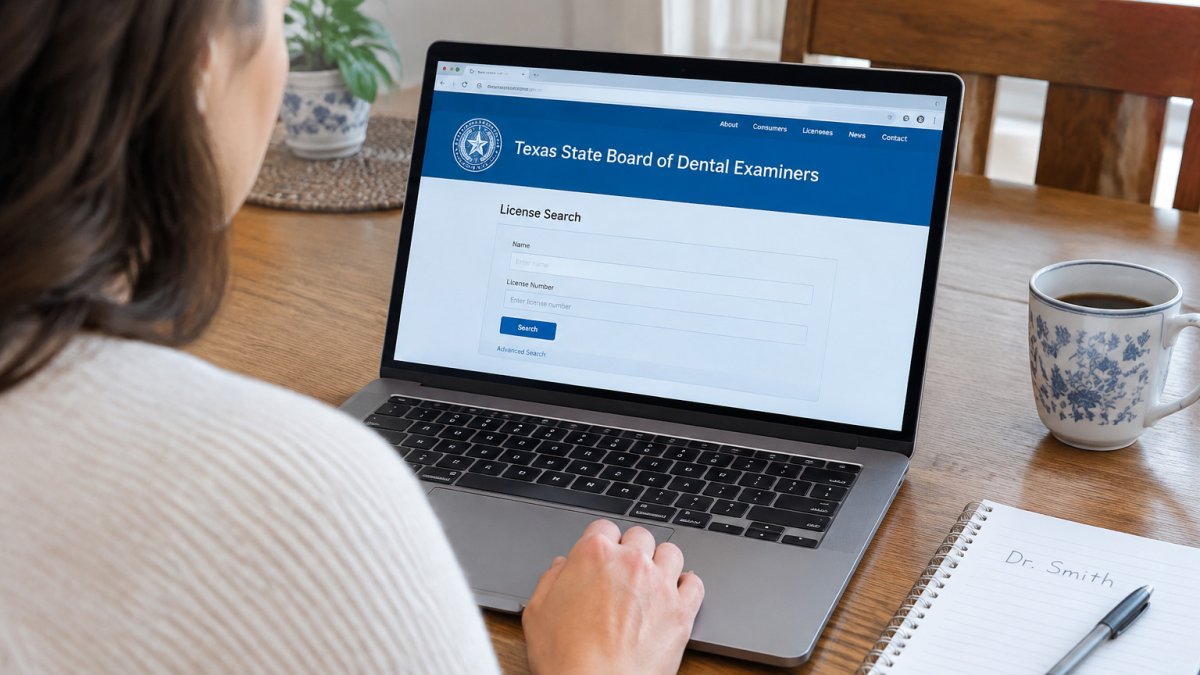
Here is a repeatable workflow that works for any state board, with Texas specifics where they matter:
- Identify the correct board. Search for the state's dental board by its official name (for example, "Texas State Board of Dental Examiners license lookup"). Use the board's own website, not a third-party directory, so you are reading the primary record.
- Search by last name first. Enter the dentist's last name, then narrow by first name, middle initial, and city. Board databases often return many similar names, and the city filter is the fastest way to isolate the right person.
- Open the individual license profile. Confirm the license type, the license number, the status, and the expiration date. Write down the license number; you will use it again.
- Check for linked disciplinary records. Many boards link public disciplinary orders directly from the license profile. If the profile shows an action, open the order itself rather than relying on a summary line.
- Repeat for any other state where the dentist has practiced. A dentist who moved recently may hold an active license in one state and an inactive or expired one in another. Both records can be relevant.
When you find the right record in Texas, review these details:
- License status: Active means the dentist can currently practice.
- Expiration date: Licenses renew on a set cycle; an expired date is a question to ask, not automatically a disqualifier.
- License number: Record it for your files and for any follow-up questions.
- Disciplinary notices: Any board action appears in the record or is linked from it.
Watch out: A failed search is not proof of anything.
If you cannot verify a license through the board's own tool, contact the board by phone or through its published contact form. Board staff can confirm whether a license exists and whether the record is current.
The steps below can be repeated for any state board, and the key record fields are listed in the table.
| Step | What to do | Time or frequency |
|---|---|---|
| Identify the correct board | Search for the state's official dental board and use its own website | Once per dentist |
| Search by last name first | Narrow by first name, middle initial and city | Each search |
| Open the license profile | Confirm license type, number, status and expiration date | Each search |
| Check disciplinary records | Open the linked order itself, not just a summary line | Each search |
| Check other states | Repeat for any state where the dentist has practiced | If the dentist has moved |
| Contact the board if needed | Call or use the contact form when a search returns nothing | When search fails |
Understanding License Status, Expiration and Credential Types
A license tells you a dentist is legally allowed to practice. It does not tell you how skilled they are at a specific procedure, so knowing the difference is part of how you verify dentist credentials properly. It also helps you ask better questions.
Common terms you may see include:
- Active: The dentist may practice now.
- Expired or inactive: The dentist cannot practice until the license is renewed or reinstated.
- General dentist: Licensed to provide a broad range of care, including cleanings, fillings and crowns.
- Specialist: Has additional training in an area such as orthodontics, oral surgery or pediatric dentistry.
Expired licenses are not always a red flag, but they deserve a clear answer. Ask the office why the status changed and when it was renewed.
Step 3: Check Board Certification and Specialty Claims
A general license is different from a specialty credential. Many dentists advertise "specialist" or "board certified" status, and these claims are worth verifying separately. The Texas board records show licensure, but specialty and board certifications usually come from national organizations.
Check specialty claims with the relevant national board. National dental certifying organizations generally publish searchable directories of certified dentists. Confirm that the name and certification match the dentist you are considering.
Be careful with vague terms. A practice may say "cosmetic expert" or "implant specialist" without holding any formal certification. These phrases describe interest and experience, not an official credential. Ask what training supports the claim.
Step 4: Check Disciplinary History and Public Records
The disciplinary history of a dentist matters more than most patients realize. The Texas board posts disciplinary actions, including license suspensions, probations and reprimands. Look for these records in the dentist's license profile and in the board's public orders.
Read disciplinary records fairly. To see other signs of a trustworthy dentist, read signs your dentist is being honest. A single complaint that was dismissed means something very different from a documented license suspension. Consider:
- How recent the action was
- Whether it involved patient care or a paperwork issue
- Whether the dentist completed any required corrective steps
- Whether there have been multiple, similar actions
If you find a disciplinary action, you do not have to decide right away. You can ask the dentist to explain it, and a good dentist will answer openly. Patients can also raise concerns about a dentist's practice with the licensing board.
Step 5: Verify Experience Beyond the License
A license confirms the minimum standard for practice.
Separate the three things people mean by "experience": what to look for in a family dentist covers the broader factors to weigh.
- Years in practice. This is the easiest to confirm and the least informative on its own. A dentist who has practiced for 20 years may have spent most of that time on general checkups rather than the procedure you need.
- Procedure-specific volume. Ask how many of the specific treatment you need the dentist performs in a typical month, and how many they have performed in the past year. A dentist who does a procedure weekly will describe a different set of typical outcomes and complications than one who does it a few times a year.
- Relevant training and continuing education. Ask where the dentist learned the procedure: a residency, a hands-on continuing education course, a mentorship, or on-the-job experience. Continuing education varies widely in intensity, so ask whether the training included supervised patient care or was lecture-only.
A practical way to check experience claims is to ask for specifics and then listen for the mechanism. A dentist with real procedure experience can usually describe:
- The typical number of visits and the expected recovery for a patient like you
- The most common complication they see and how they manage it
- The cases they refer out, and why
- What they would do differently for a patient with your specific health history or anxiety level
Vague or defensive answers are worth a second look, but so are overly confident ones.
Experience also varies by age group and by treatment type.
Watch out: Do not treat a specialty title, a weekend course certificate, or a practice website's "implant specialist" language as proof of procedure volume.
Questions to Ask a New Dentist Before Your First Visit
Before you commit to a new dentist, ask these questions by phone or at a consultation:
- What is your license number, and where can I verify it?
- Do you hold any specialty or board certifications?
- How long have you treated patients in this area?
- What is your approach for patients who feel anxious?
- How do you explain treatment options and costs before starting work?
- Do you recommend a second opinion for major procedures?
A good dental office welcomes these questions. If a practice discourages them, that tells you something about how they will communicate later.
Request written treatment plans and cost estimates before agreeing to major work. Compare the plan to what another dentist recommends if you are unsure. Honest dentists expect this and are comfortable with it.
Booking Your Verified Family Dental Visit at Franklin Dental Center
Once you have verified a dentist's credentials, the next step is a visit that fits your family. At Franklin Dental Center, we welcome patients of all ages, including children who need a gentle first visit and adults managing dental anxiety. Our team is led by Dr. Donna Franklin-Pitts, and you are welcome to verify her license and experience using the steps above before your first appointment.
Ask us any question from this guide when you contact us, and we will walk you through what we can share. Request an appointment today to start building a dental relationship grounded in clear information and trust.
Frequently Asked Questions
What credentials should I look for in a dentist?
Start with an active Texas dental license, confirmed through the Texas State Board of Dental Examiners online lookup. Check that the license status is active, not expired or suspended, and that the name matches the dentist's identification. Beyond licensure, look for relevant training, continuing education and any board certification in a specialty the dentist advertises. These credentials show the dentist has met state requirements and maintains current knowledge. Verification can be done before you book.
How do I check if a dentist has had disciplinary actions?
Search the Texas State Board of Dental Examiners public records for the dentist's name and license number. Licensing boards generally make disciplinary information available, so review any listed actions and their dates. A single old or minor matter is not the same as a pattern of serious violations, so read the details before drawing conclusions. If you have questions about what you find, ask the dentist directly during a consultation.
Is board certification required for a general dentist?
No. A general dentist practicing in Texas needs a valid state license to provide general dental care. Board certification is generally a voluntary credential in a recognized dental specialty. If a dentist advertises a specialty, confirm that claim through the appropriate certifying board. Certification adds a layer of verified training, but a general dentist can still provide routine checkups, cleanings and restorative work without it.
Do I need to verify a new dentist's credentials if I have been seeing them for years?
Periodic checks are still worthwhile, especially if a dentist has changed names, moved practices or added new services. Licenses must be renewed, so confirming an active status keeps your records current. Verification is also useful when a family member begins care with the same dentist. A quick search on the state board's lookup tool and a review of any new disciplinary listings provides a simple, low-effort confirmation.