 blog
blog
Reliable Restorative Dentistry Services in Tyler
Table of Contents
- What Restorative Dental Procedures Can Address
- Common Restorative Dentistry Options for Damaged and Missing Teeth
- How to Choose a Restorative Dentist You Can Trust
- What to Do If Your Temporary Crown Fell Out
- Why Comprehensive Dental Care Matters for Long-Term Oral Health
- Managing Dental Anxiety During Restorative Treatment
- Frequently Asked Questions
Last Updated: October 10, 2026
What Restorative Dental Procedures Can Address
Restorative dentistry services repair and rebuild damaged or missing teeth caused by decay, injury, age, or structural damage. These treatments restore function and appearance while addressing root causes and preventing complications that affect overall health.
Tooth damage creates real problems: cracked teeth trap bacteria and lead to infection, missing teeth shift surrounding teeth and affect your bite, and gaps impact your confidence and quality of life.
Modern restorative dentistry offers multiple solutions tailored to your situation, from quick procedures to complex treatments delivering results that last decades.
Common Restorative Dentistry Options for Damaged and Missing Teeth
Restorative dentistry services include several proven approaches suited to different problems. Understanding your options, the process, and recovery expectations helps you make informed decisions.
Crowns and Bridges
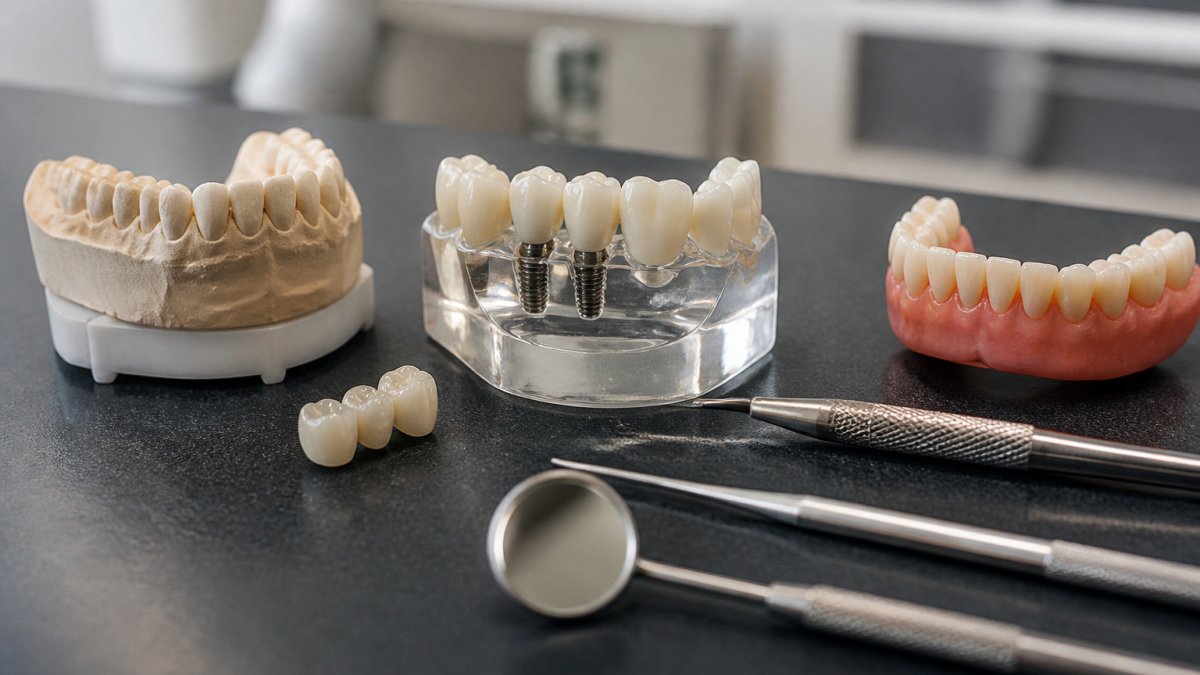
A dental crown is a custom-made cap that covers a damaged tooth completely, restoring strength to teeth weakened by large fillings, root canals, or cracks. Crowns also support bridges, artificial teeth that span gaps where one or more teeth are missing.
Bridges anchor to healthy teeth on either side of the gap, restoring chewing ability and preventing remaining teeth from shifting. Both crowns and bridges match your natural teeth in color and shape for a seamless appearance.
Treatment Process and Timeline
The crown and bridge process typically takes two appointments.
First appointment: Your dentist examines the tooth with X-rays, removes any decay, and prepares the tooth by removing a thin layer of enamel. Digital impressions are sent to a lab to fabricate your permanent restoration. A temporary crown is placed with temporary cement to protect the tooth and maintain your bite and appearance.
Second appointment: Your dentist removes the temporary crown, checks the fit and color of the permanent restoration, adjusts the bite if needed, and cements it in place with permanent adhesive.
Recovery and Aftercare
There is no downtime after a crown is placed. You can eat and drink normally immediately, though avoid very hard foods for 24 hours while cement sets. Mild temperature sensitivity may occur for a few days and usually resolves within a week.
Crowns and bridges require the same care as natural teeth: brush twice daily, floss daily, and avoid hard objects. With proper care, crowns and bridges can last for many years.
Candidacy Factors
Crowns work best on teeth with adequate remaining structure (if more than 50% is missing, a crown may not be possible). Bridges require healthy anchor teeth on both sides; if those teeth are severely decayed or have weak roots, they cannot support a bridge. For multiple missing teeth, implants or dentures may be more appropriate.
Dental Implants and Dentures
Dental implants offer a permanent solution for missing teeth. A titanium post is surgically placed in the jawbone and topped with a custom crown.
Dentures provide a removable alternative for patients missing multiple teeth or entire arches. Same-day dentures allow you to leave with functional teeth but require adjustments as your mouth heals. Traditional dentures are fabricated over a few weeks for a precise fit.
Implant Treatment Process and Timeline
Dental implant placement is a multi-stage process.
Stage 1 - Surgical placement: Your dentist or oral surgeon administers anesthesia, makes a small incision to expose the jawbone, drills a hole to the precise depth, and inserts the titanium post.
Stage 2 - Osseointegration: The implant post fuses with the jawbone. You cannot chew on that implant during this time. A temporary tooth may be placed to maintain appearance but won't bear chewing force. Follow-up appointments monitor healing.
Stage 3 - Abutment and crown placement: Once osseointegration is complete, your dentist places an abutment on the implant post and takes an impression for the crown. A temporary crown is placed while the permanent crown is fabricated.
Implant Candidacy
Implants require adequate jawbone volume and density. Bone loss from years of missing teeth may require bone grafting before implant placement, adding to the overall treatment time and cost. Implants work best for patients with good oral hygiene and no active gum disease.
Denture Treatment Process and Timeline
Traditional dentures: Your dentist takes impressions and measurements, creates a wax model for preview, and fabricates the denture in a lab. At your appointment, it's fitted and adjusted. You'll receive care instructions and typically need adjustment appointments.
Same-day dentures: A pre-fabricated denture is fitted and adjusted during your visit, allowing you to leave with functional teeth the same day. However, they require more adjustments over the following weeks as your gums heal and reshape. (Source: the average lifespan of dental restorations)
Denture Candidacy and Care
Dentures suit patients who prefer a removable option, cannot undergo surgery, have lost multiple teeth, or have severe bone loss. They require daily cleaning with a denture brush and denture cleaner (not toothpaste).
Implant-Supported Dentures
Implant-supported dentures combine implant stability with removable convenience. Two to four implants are placed and the denture clips onto them, preventing slipping, improving chewing force, and preserving more bone than traditional dentures. However, they cost more and require good oral hygiene.
Fillings and Bonding
For cavities and minor damage, tooth-colored composite fillings bond directly to your tooth and match your natural color. Bonding is another option for small chips, gaps, or discoloration, your dentist applies tooth-colored resin, shapes it, and hardens it with light. Bonding is quick, affordable, and requires no tooth preparation.
Treatment Process
Both fillings and bonding typically take one appointment. For a filling, decay is removed and the cavity is filled with composite material in layers, hardening each with light. For bonding, resin is applied, shaped, and hardened. No recovery time is needed; you can eat normally immediately.
Longevity and Limitations
Fillings and bonding can last for several years, though bonding is more prone to staining and chipping. Both are less durable than crowns for large damage or frequent hard chewing. Repeated replacements in the same tooth may eventually require a crown.
How to Choose a Restorative Dentist You Can Trust
Choosing the right dentist for restorative work matters because these procedures are complex, costly, and affect your comfort and appearance for years. Reliability requires verifiable credentials, transparent practices, and a track record of lasting outcomes.
Credentials and Continuing Education
Verify your dentist holds a DMD or DDS degree from an accredited school and is licensed by your state (the American Dental Association). For complex work, ask about additional certifications. Look for experience with your specific procedure.
Warranty and Guarantee Policies
Ask whether your dentist offers a written warranty on restorations. Request the warranty in writing before treatment begins. If a restoration fails early due to the dentist's error, a reliable practice covers replacement costs.
Transparent Pricing and Insurance Clarity
Request a written treatment estimate that itemizes each component (surgical placement, abutment, crown, bone grafting if needed). Ask your dentist to explain what affects cost: material, case complexity, and additional imaging or bone grafting.
Ask your dentist's office to submit a pre-authorization request to your insurance company to estimate coverage and your out-of-pocket cost. Reliable dentists accept multiple insurance plans, explain in-network vs. out-of-network benefits, and discuss payment plans or financing options.
Patient Reviews and Verifiable Outcomes
Read reviews on Google, Healthgrades, and Zocdoc, looking beyond star ratings for detailed comments about comfort, communication, and whether options were explained clearly. Pay attention to mentions of "gentle care," "took time to listen," and "results lasted."
Follow-Up Care and Accessibility
Ask about follow-up protocol: Do they schedule check-ups after crowns? Do they monitor implants annually with imaging? Do they provide written aftercare instructions? Ask about emergency access: can you reach the dentist the same day or next morning if your restoration breaks?
Assess accessibility: Do they offer appointment times that work for your schedule? For anxious patients, ask about sedation options and experience managing dental anxiety.
Approach to Tooth Preservation
A restorative dentist who values your natural teeth will explore every option to save them before suggesting extraction. Ask: "What would you do to save this tooth before recommending removal?" Natural teeth, even if restored, are almost always preferable to replacements because they preserve jawbone and maintain your bite.

What to Do If Your Temporary Crown Fell Out
If your temporary crown falls out, call your dentist immediately. Until then, protect the tooth by avoiding chewing on that side. Do not use super glue or permanent adhesives. If your dentist is unavailable, visit an urgent care dental clinic. Once reattached, stick to soft foods and avoid sticky foods like caramel or taffy.
Why Comprehensive Dental Care Matters for Long-Term Oral Health
Restorative dentistry services work best within a comprehensive approach to oral health. Regular cleanings, checkups, and preventive care catch problems early. A comprehensive dentist identifies root causes, decay, grinding, bite problems, or gum disease, and addresses all of them. Many patients have fillings replaced repeatedly or crowns fail early because the underlying issue was never treated. At Franklin Dental Center, we focus on understanding why your teeth are failing, so you spend less time in the chair and get results that last. Long-term oral health depends on how well you care for your restorations: brush and floss daily, attend regular checkups, and follow your dentist's specific care instructions.
Managing Dental Anxiety During Restorative Treatment
Many people avoid restorative dentistry services because of anxiety about dental work. Tell your dentist about your fears upfront. Many practices offer sedation options, from mild nitrous oxide to deeper sedation. Ask your dentist to explain what they're doing and to pause if you need a break. Many dentists use a hand signal system, raise your hand and they stop immediately. Bring headphones and listen to music or a podcast. These adjustments make a real difference for anxious patients. Dr. Donna Franklin-Pitts and the team at Franklin Dental Center specialize in gentle care for anxious patients, prioritizing your comfort with a calm, unhurried manner.
Restorative dentistry services address real problems that affect how you eat, speak, and feel about yourself. Whether you need a simple filling or a complex implant restoration, the right dentist makes all the difference. Choose a dentist who listens, explains your options, and focuses on long-term results rather than quick fixes.
Franklin Dental Center provides comprehensive restorative dentistry services tailored to your needs. We accept multiple insurance plans, offer flexible payment options, and prioritize your comfort throughout treatment. Our team has the experience and gentle approach to handle even complex restorations. Request an appointment today and let us help you restore your smile and your confidence in your oral health.
Frequently Asked Questions
What is considered a restorative dental procedure?
Restorative dental procedures repair or replace damaged, decayed, or missing teeth to restore function and appearance. Common procedures include fillings for cavities, crowns to cap damaged teeth, bridges to replace missing teeth, dental implants that act as artificial tooth roots, and dentures for multiple missing teeth. These treatments address problems ranging from decay and trauma to tooth loss, helping patients maintain oral health and natural-looking smiles.
What should I look for when choosing a restorative dentist?
Evaluate a restorative dentist based on their experience with the specific procedures you need, whether they accept your insurance or offer flexible payment options, and how they approach patient comfort. Ask about their qualifications and experience. Read patient reviews focusing on comments about gentleness and clear communication. A good restorative dentist takes time to explain your options, listens to your concerns, and helps you understand what treatment you actually need.
What should I do if my temporary crown fell out on the weekend?
If your temporary crown falls out, contact your dentist immediately, even if it's after hours. In the meantime, avoid chewing on that side of your mouth and try to keep the tooth clean. If you can find the crown, rinse it gently and store it safely. Do not attempt to reattach it yourself. Temporary crowns protect the prepared tooth underneath; leaving it exposed increases the risk of damage or infection. Your dentist will either recement the crown or create a new one to protect the tooth until your permanent restoration is ready.
How do I know whether I need a crown, filling, or dental implant?
The right restoration depends on the extent of tooth damage or loss. Fillings work for small to moderate cavities. Crowns cover teeth with large cavities, cracks, or after root canal therapy. Dental bridges replace one or a few missing teeth by anchoring to adjacent teeth. Implants replace missing teeth with an artificial root and crown, requiring healthy jawbone. Your dentist will examine the tooth, take X-rays, and discuss your goals and budget to recommend the best option. Each choice has different costs, longevity, and maintenance requirements.